THE GOLDEN RULE
Complete a set—or win.
A discard is not a spare tile for later. For an ordinary claim it must immediately complete an allowed set, which you then expose. A discard can also complete your winning hand, including the final Pair where the rules allow it. If the tile merely looks useful for later, leave it.
A FOUR-QUESTION CHECK
May you claim this discard?
Does it complete a set—or your winning hand?
If the tile is merely useful for later, you cannot claim it. It must complete an allowed set or a winning hand. Buying is a separate rule used only in formats that allow it.
Which set or winning Pair does it complete?
Chow, Pung, Kong and larger-set claims depend on the format and hand. A winning discard can also complete the final Pair where that game's rules permit it.
Who discarded it?
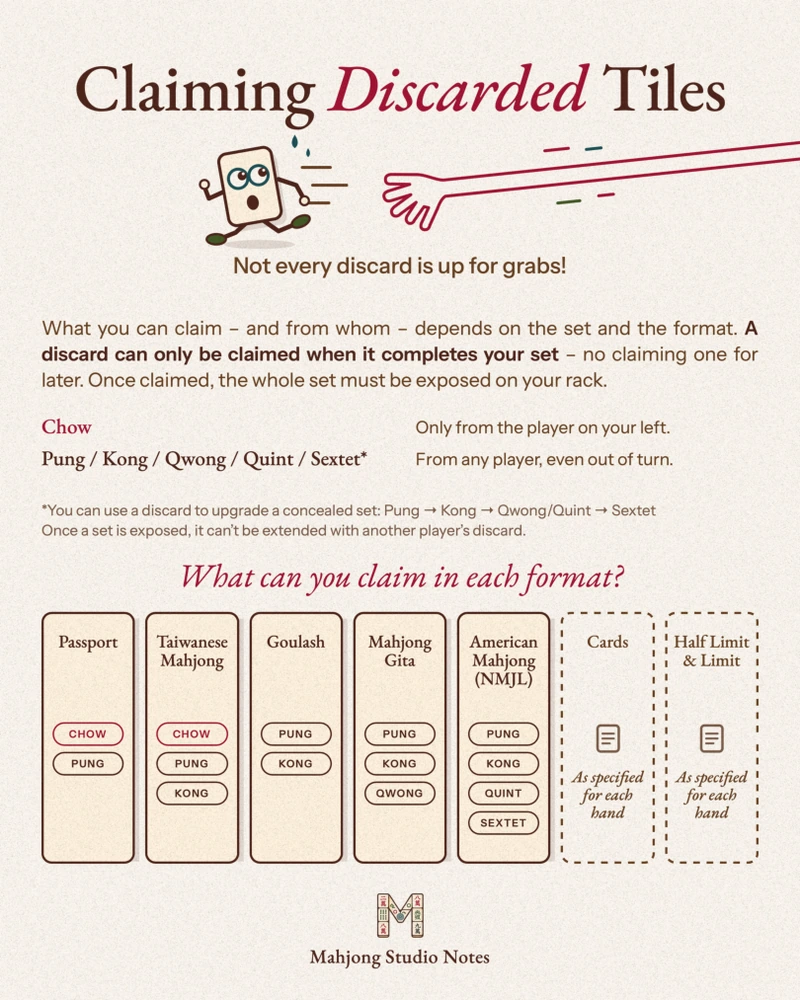
A Chow may be claimed only from the player on your left. Other permitted matching sets may be claimed from any player, even out of turn.
Is the set already exposed?
A discard may upgrade a concealed set where the format permits it. It cannot extend a set that is already exposed.
TWO QUICK EXAMPLES
Who discarded it matters.
CHOW · FROM YOUR LEFT
You hold 3 and 4 Bamboo.
The player on your left discards 5 Bamboo. In a format allowing Chows, you can claim it to show 3–4–5 Bamboo. If another player discarded it, you cannot claim it for a Chow.
PUNG · FROM ANY PLAYER
You hold two Red Dragons.
Another player discards the third. In a format allowing Pungs, you may claim it—even out of turn—and expose the three matching Dragons.
THE TRAP
An exposed set cannot grow on a discard.
You may sometimes use a discard to upgrade a concealed Pung into a Kong, or a concealed larger group into the next permitted set. But once a set is exposed, you cannot claim another player's discard to extend that exposed set. It's a small distinction that changes what you should reveal.
CHECK YOUR FORMAT
The permitted sets aren't universal.
PASSPORT
Chow · Pung
Remember the left-player rule for Chows.
TAIWANESE
Chow · Pung · Kong
A Kong claim needs three matching tiles concealed.
GOULASH
Pung · Kong
Holding two tiles for a Chow isn't enough.
MAHJONG GITA
Pung · Kong · Qwong
Bigger sets can be part of the game.
AMERICAN (NMJL)
Pung to Sextet
Pung, Kong, Quint and Sextet—subject to the hand being played.
CARDS · HALF LIMIT & LIMIT
Follow the hand
The particular hand determines which claims are permitted.
ONE MORE DISTINCTION
Claiming isn't buying.
Claiming finishes and exposes a set. Buying a tile—only in formats that allow it—can add an otherwise useful discard to your concealed rack without completing a set, usually at a points cost. Before calling across the table, ask which action you're actually allowed to take.
A HANDY TABLE REFERENCE
Settle the claim in one look.
Not sure whether a Qwong or Quint can be claimed in your game? Keep Mahjong Studio's seven-format comparison to hand.
See the Instagram chart ↗