BEFORE THE FIRST DRAW
Think of the Charleston as a chance to edit your hand.
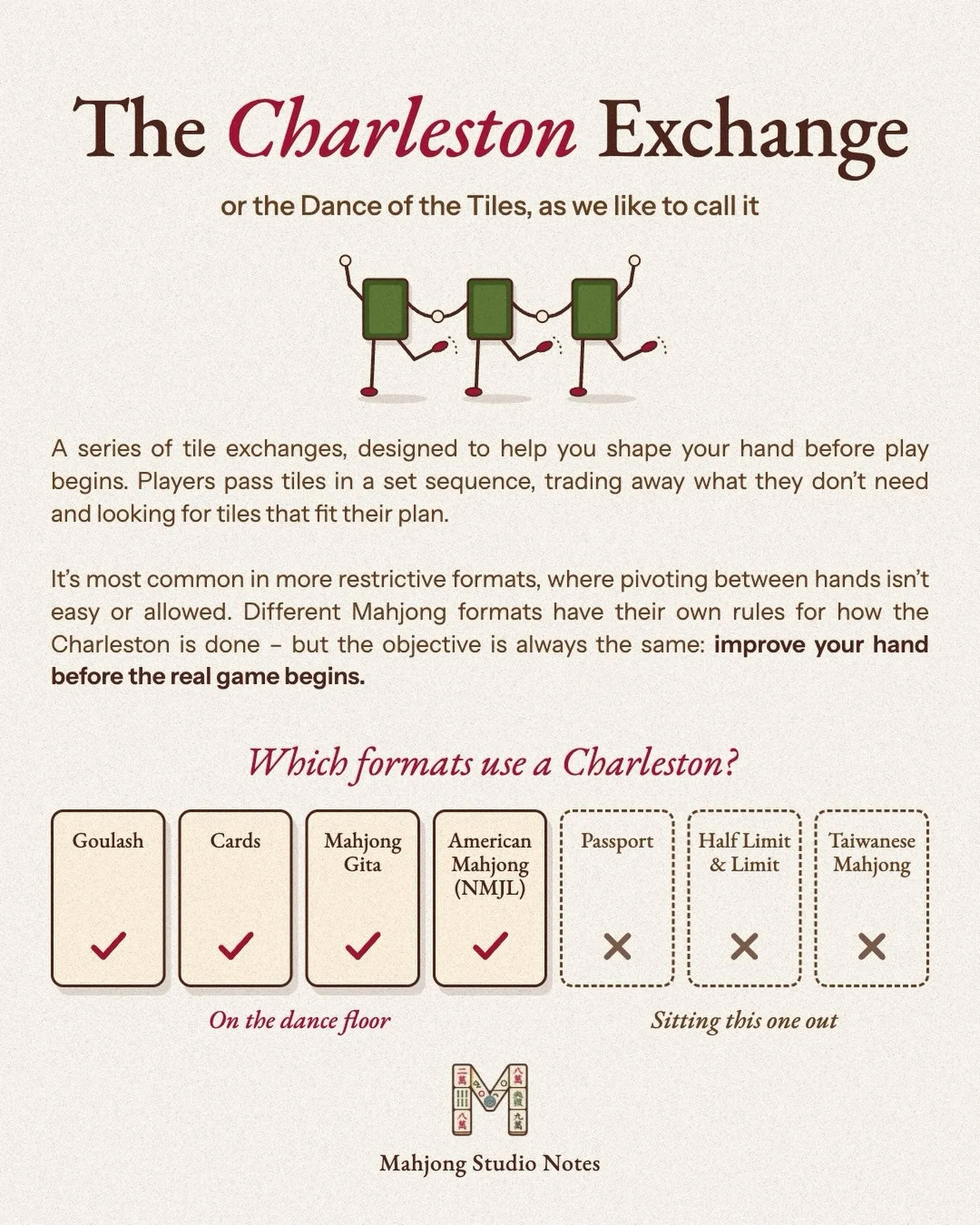
A Charleston is a sequence of tile exchanges before normal play. You pass away tiles that don't fit your plan and receive new ones. The goal isn't simply to get rid of unwanted tiles; it's to give your opening hand a clearer direction.
AN EASY WAY TO THINK ABOUT IT
Pass the tiles that have the least to do.
STEP 1
Spot the promising groups.
Look for pairs, related numbers and suits that might grow into the hand your game requires.
STEP 2
Protect your best starting tiles.
If several tiles already support the same plan, think carefully before passing them away.
STEP 3
Use what comes back.
New tiles may reveal a better direction. The Charleston gives you time to adjust before the first discard.
DOES YOUR GAME DANCE?
Not all Mahjong formats exchange tiles.
YES
Goulash · Cards · Mahjong Gita · American Mahjong
These games use a Charleston in Mahjong Studio's comparison, although the exact passing sequence differs.
NO
Passport · Half Limit & Limit · Taiwanese Mahjong
These are played without the pre-game Charleston in the same comparison.
DON'T MIX RULEBOOKS
The passing sequence isn't universal.
You can understand the purpose of the Charleston without knowing every variation by heart. But once you choose a format, use that format's exact passing sequence. Don't import an American Mahjong passing rule into Goulash or Cards.
KEEP THE VISUAL GUIDE HANDY
Have a new player at your table?
A quick look at the seven-format comparison can settle whether to start exchanging tiles—or go straight to the wall.
Check the Charleston formats ↗