MEET THE THREE
They don't look much like dragons.
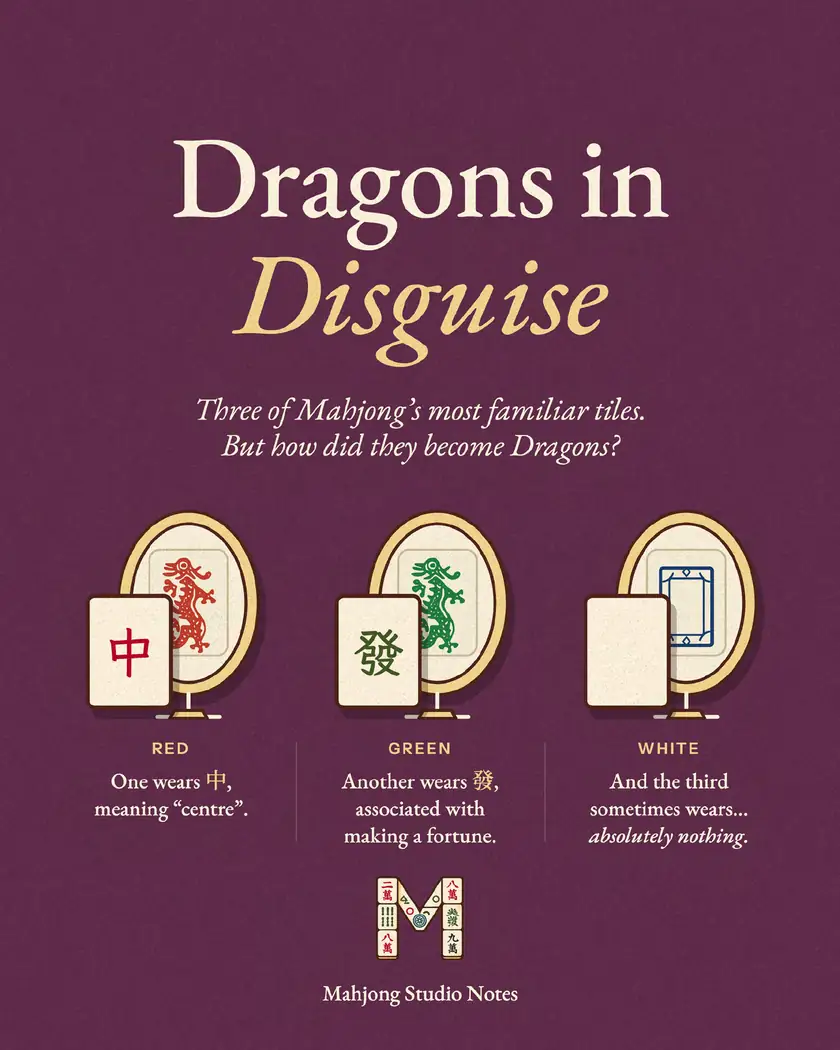
One wears the character 中, meaning “centre”. Another wears 發, associated with making a fortune. The third may wear absolutely nothing at all. Together, these are the tiles we now call the Red, Green and White Dragons.
RED DRAGON
Zhōng · Centre
The character that once kept company with the Winds.
GREEN DRAGON
Fā · Fortune
Associated with fācái: getting rich.
WHITE DRAGON
Báibǎn · Blank
A plain face with more names than you might expect.
THE HISTORICAL RECORD
How the trio came together.
The earliest sets described in Mahjong Studio’s illustrated history were collected in China in the 1870s by the American George Glover. They did not yet have the familiar group of three Dragons. They did contain Centre and Blank tiles.
A set collected in Ningbo in 1889 by Britain’s William Wilkinson included Fā, the tile that would become the Green Dragon. The now-familiar trio had taken shape in the surviving record. Western marketing later helped popularise calling them “Dragons”.
A historical distinction: 1889 is a date in the surviving record, not a proven birthday for the Green Dragon.
RED DRAGON
Red: the overachiever.
中 is Zhōng (“centre”). Some Red Dragons carry a small C, from Chung, an older spelling of the name. In Glover’s sets it appeared alongside East, South, West and North; researchers have suggested that it might have represented a fifth direction: Centre.
A POSSIBLE FIFTH DIRECTION
North · West · Centre · East · South
An interpretation of the early tile grouping, not a settled account of how the Dragon tile originated.
Another story ties Red to China’s imperial examinations. To “hit the mark” was to pass the famously difficult exams and begin a new life as a court official. It makes Red the ambitious first act of a story, but the examination tale is an interpretation, not a proven origin.
GREEN DRAGON
Green: the fortune hunter.
The character 發 is Fā, associated with 發財 (fācái), “to get rich”. Some sets add a little F. In the examination story, Red passes the test and Green represents what comes next: salary, position and opportunity.
Unlike Centre and Blank, Green is missing from those early 1870s Glover sets. It is present in the documented 1889 Ningbo set. A later arrival in the records—but it became an indispensable member of the trio.
Hit the mark, and fortune followed.
WHITE DRAGON
White: a perfectly blank reputation.
The White Dragon is also called 白板 (Báibǎn): the “white board” or blank tile. In early sets it could be completely unmarked. In the examination story, White represents the honest official’s clean record: not a single blot on the page.
That blank face created a practical problem. Older tiles had bone faces and bamboo backs, making the front obvious. When single-colour tiles became common, a blank Dragon was harder to distinguish from a spare blank. Many makers added a border or a small letter to identify it.
The P and B reflect different English spellings of the name for white. And yes, some White Dragons still wear nothing at all.
NICKNAMES & FOLKLORE
Three tiles, a world of stage names.
RED
“Red centre”
紅中 is a familiar name. Another nickname is “the red sword”, referring to the character’s long hanging stroke. The Red Dragon even has a recognisable Mahjong emoji: 🀄.
GREEN
“Get rich”
發財 carries the fortune association. Mahjong Studio’s illustrated lesson also records a Taiwanese pun on qīngwā (“frog”), and a playful name linked to Chow Yun-fat.
WHITE
“Soap”, “Tofu”…
The blank tile has picked up names such as Soap in America, Tofu in some Japanese clubs, and even “the television” or “the misprint”. Usage varies by place and table.
There is also a lovely interpretation linking Red with benevolence, Green with sincerity and White with respect for one’s parents. Like the imperial-examination story, it should be appreciated as a symbolic reading—not presented as the established reason these tiles began.
MORE THAN MEETS THE EYE
Three familiar faces, different pasts.
中RedA possible former direction.
發GreenA later arrival in the surviving record.
□WhiteA blank with a reputation.
The dates and early sets help tell their history. The examinations, virtues and nicknames tell us something different: how people have enjoyed explaining these little tiles. Which Dragon will you look at differently the next time you play?
FROM OUR ORIGINAL NOTES
Curious about the stories in your set?
This article adapts Mahjong Studio’s illustrated 12-page Dragons in Disguise lesson, preserving its distinction between historical evidence and favourite explanations. Explore more visual tile stories from Mahjong Studio.
Visit Mahjong Studio on Instagram ↗Sources and historical context
This article adapts Mahjong Studio’s original 12-page Dragons in Disguise illustrated lesson. For independent research on the early collected sets, see The Mahjong Tile Set’s historical discussion. For the Western “Dragon” label and popular interpretations, see Mahjong Madame’s historical overview. These readings help distinguish a documented set or later explanation from a proven original meaning.